
Happy Saturday,
It's because of weeks like this that I bought a lakeside cottage, far from the city, far from the noise.
Somehow.. for me anyways.. the markets seem easier to evaluate objectively when I'm removed from the hype... lot's of reading, doing my own research, sitting on the dock.. CNBC turned off.
Let me walk you through last weeks damage.
The S&P 500 finished off about 1.6 percent, the Dow gave back roughly 0.9 percent, and the Nasdaq Composite took the worst of it at nearly 2.9 percent.
Second-quarter earnings season opened with the big banks generally beating expectations, and a cooler-than-expected June inflation reading gave stocks a lift on Tuesday. For a moment, it looked like the calm might hold.
But.. the technology and semiconductor complex rolled over. The chip ETFs had an ugly stretch, with the semiconductor group posting one of its worst weeks in months on renewed anxiety about how much companies are really willing to spend on AI.
IBM had one of it's worst weeks in history and Netflix slid on soft guidance.
Fortunately, what I have learned in my 30-plus years at this is that there is always an opportunity... and right now those opportunities are coming out of the energy sector.
Commentary about the wars aside, the ongoing conflict continues to throw off both volatility and liquidity in energy names. So let me give you two ways to play it... with volatility, or without it.
2 ways to play the Energy Sector, with or without volatilty
Here's a low vol approach from profoundly unexciting company.
Duke Energy (DUK) declared a raised quarterly dividend of $1.085 per share, up from $1.065... its thirteenth consecutive annual increase, from a company that has paid dividends since 1926.
NYSE: DUK $126.86 USD ... dividend yield about 3.4 percent
At a share price in the mid-$120s, that puts the yield around 3.4 percent. That is a respectable, steadily growing payout... 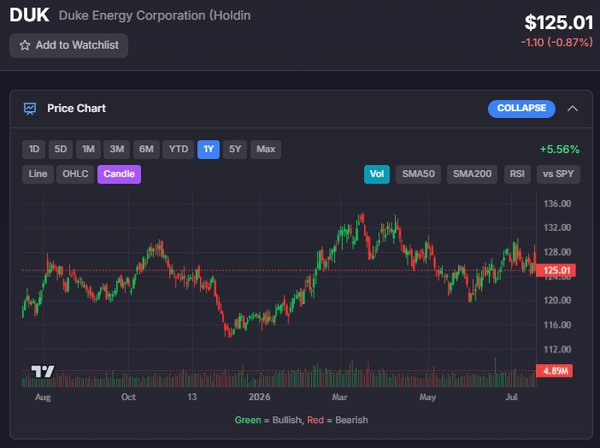
Editor's note: CNBC nicknamed him "The Prophet." He called Netflix at 78 cents, Apple at 38 cents, and Amazon at $2.80 – long before anyone knew their names.
He's appeared on 60 Minutes twice. Now former hedge-fund manager Whitney Tilson is naming what he calls "America's Greatest Retirement Stock" right now –
One company at the center of the AI and energy boom.
He's giving away the name and ticker, free.
Now the high-volatility way, from a company you may have never heard of.
Forget the oil itself for a second. Think about the boats that carry it.
When the Strait of Hormuz gets choked, tankers cannot take the short route... they sail the long way around, war-risk insurance premiums spike, and suddenly there are not enough ships to move the world's crude.
Day rates for the big supertankers, the VLCCs, have rocketed toward $470,000 a day at the peak of this crisis, up from the tens of thousands in a normal market.
The companies that own those ships have been among the best-performing stocks in the entire market this year.
The cleanest way to play it is DHT Holdings.
NYSE: DHT $17.84 USD ... 52-week range $10.61 to $20.55
DHT is a pure supertanker company.
It owns and operates VLCCs, the largest crude carriers on the water, and almost nothing else.
No refineries, no drilling, no complicated story... just steel hulls hauling oil at whatever the market will pay. When Hormuz disruption sends rates through the roof, DHT's earnings go with them.
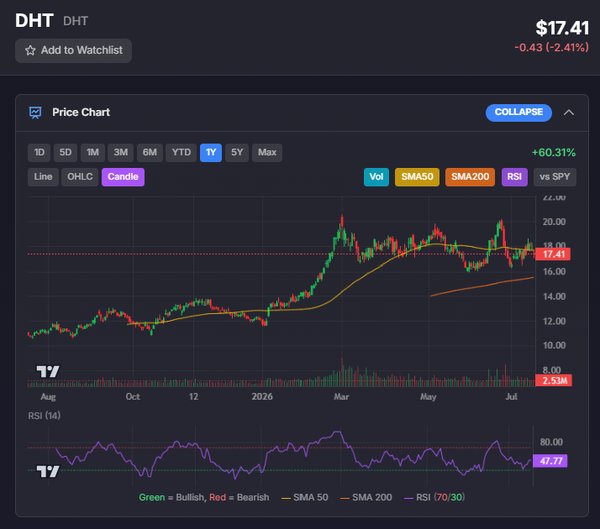
Look at that 52-week range again... roughly ten dollars to twenty.
It nearly doubled and gave a chunk back, all inside twelve months.
That is what "highly volatile" actually looks like on a chart.
But I will be straight with you, because that is the whole point of this letter.
The very thing driving this trade, the Hormuz disruption, is also the risk. If Washington and Tehran genuinely de-escalate and the strait reopens for good, tanker rates can fall as fast as they rose... and so can the dividend and the share price.
Iran sold 90% of its oil to China. Venezuela, 80%. Both supply lines were cut in 60 days.
Dear Friend, Here’s the story behind the story. Iran sold 90% of its oil to China. Venezuela was quietly shipping 80% of its exports to the same buyer.
Within 60 days, both supply lines were severed. This was never really about the Middle East. It was about starving China’s AI power grid.
Because whoever powers their AI first sets the rules for the next 50 years -
This is not Duke. You do not tuck DHT away and forget it.
You own a name like this with your eyes open, in a size you can afford to be wrong on, and you watch the strait like a hawk.
-Greg
More related research.
(sponsored) Iran War Shock: What I Was Told In That Private Meeting
Disclaimer:
This content is for informational and educational purposes only and does not constitute financial, investment, or trading advice. All opinions expressed are based on publicly available data believed to be reliable but are not guaranteed for accuracy or completeness. Investing and trading involve risk, including the possible loss of principal. Always perform your own due diligence and consult with a qualified financial advisor before making investment decisions. Past performance is not indicative of future results. Paid ads from 3rd parties are clearly identified. We do NOT specifically endorse these products nor are we responsible for the content of these ads. You should assume an affiliate payment will be made to us if you click a link or buy a product.